Spec-Driven AI Tools (Part 1)
Neil Haddley • September 29, 2026
Running OpenSpec's full propose-apply-sync-archive cycle twice, for a Programmer Mode and a Statistics Mode on a plain-JS calculator, to see whether its delta specs really do become a living, accurate source of truth
I read Ran the Builder's honest take on three spec-driven AI tools and wanted to find out for myself whether the workflows hold up, rather than take the scores at face value. This is the first of four posts: one each for OpenSpec, Spec-Kit, and BMAD, then a comparison. Same starting project and the same feature requests each time, so the results are actually comparable, not three unrelated write-ups.
The task
I did not want a todo-app rehash, so I built a real fixed point of comparison instead: a plain HTML/CSS/JS calculator, a flat, boxy, monochrome homage to the Windows 1.0 (1985) Calculator, which really did ship as a simple four-function tool. I then give every tool the same two feature requests, taken from real Windows Calculator history rather than invented for the occasion:
- Programmer Mode — Windows Calculator got a dedicated Programmer mode in Windows 7 (2009): switching between binary, octal, decimal, and hexadecimal, with defined bit widths (byte/word/dword/qword) and integer-only arithmetic. Base conversion itself is older, part of the Scientific mode Windows 3.0 added in 1990, but Windows 7 is what split it into its own mode with real bit-width and overflow semantics.
- Statistics Mode — also added in Windows 7: enter a sequence of numbers, click Add for each one, and get sum, average, sum-of-squares, average-of-squares, and both sample and population standard deviation. Not plotting — a genuinely common mix-up, since Calculator's later Graphing mode (Windows 10, 2019) is the one that actually draws a curve.
(Both details checked against Wikipedia's Windows Calculator article before I built the framing in.)
I wrote the feature requests the way I would naturally ask for them, not engineered to hit specific traps I already expected from reading the article. Whatever ambiguity OpenSpec surfaces or misses below is discovered after the fact, not scored against a checklist I wrote myself.
The baseline
The calculator lives at github.com/Haddley/specdriven. The calculation engine (calculator-logic.js) is separated from the DOM wiring (calculator.js), so it is directly testable: twelve tests cover the four operations, chained entry, decimal input, and division by zero. Operators chain left-to-right as entered, the way a plain calculator works, not by operator precedence — a design decision I wrote down in the README before any spec-driven tool got involved, since that is exactly the kind of thing a tool could otherwise silently assume differently.
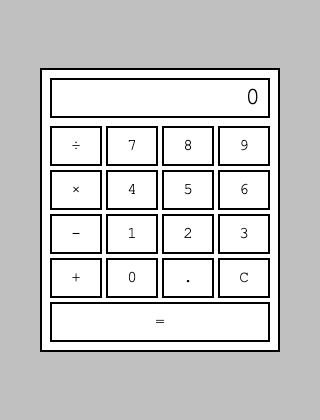
The baseline calculator, freshly loaded — flat, boxed, monochrome, no gradients or rounded corners
BASH
1npm test
CODE
1✔ adds two numbers
2✔ subtracts two numbers
3✔ multiplies two numbers
4✔ divides two numbers
5✔ division by zero shows an error and blocks further input until clear
6✔ chains operators left-to-right, not by operator precedence
7✔ decimal input builds a fractional number
8✔ a second decimal point in the same entry is ignored
9✔ starting a new number after an operator replaces the display rather than appending
10✔ equals with no pending operator is a no-op
11✔ formatNumber rounds away floating-point noise
12✔ clear resets the engine to its initial state
13ℹ tests 12
14ℹ pass 12
15ℹ fail 0
All twelve pass. That is the fixed commit every tool starts from.
Installing OpenSpec
BASH
1npm install -g @fission-ai/openspec@latest
OpenSpec needs Node.js 20.19.0 or higher; I am on v26.7.0. Then, inside the calculator project:
BASH
1openspec init --tools claude
CODE
1- Creating OpenSpec structure...
2▌ OpenSpec structure created
3- Setting up Claude Code...
4✔ Setup complete for Claude Code
5
6OpenSpec Setup Complete
7
8Created: Claude Code
96 skills and 6 commands in .claude/
10Config: openspec/config.yaml (schema: spec-driven)
11
12Getting started:
13  Start your first change: /opsx:propose "your idea"
That scaffolds openspec/specs/ and openspec/changes/archive/, both empty, plus six /opsx:* commands under .claude/commands/opsx/ — explore, propose, apply, update, sync, archive — and a matching skill for each under .claude/skills/.openspec/config.yaml also has an optional context: field, for tech stack and conventions you want every proposal to inherit:
YAML
1schema: spec-driven
2
3# Project context (optional)
4# This is shown to AI when creating artifacts.
5# Add your tech stack, conventions, style guides, domain knowledge, etc.
I am leaving it empty on purpose. Filling it in would mean telling the tool up front to use vanilla JS, keep the logic/DOM split, and so on — handing it answers to some of the exact ambiguities I actually want to watch it navigate on its own. A team adopting OpenSpec on day one, on a small project, often has not written that file yet either.
Proposing Programmer Mode
PROMPT
1/opsx:propose Add a Programmer Mode, like calculators have had since Windows 7 — support switching to binary, octal, and hexadecimal, and calculating in those bases.
OpenSpec did not ask a single clarifying question. It read the repo, made a add-programmer-mode change, and wrote four artifacts in one pass: proposal.md, a spec delta at specs/programmer-mode/spec.md (seven requirements, seventeen scenarios), design.md, and tasks.md (thirteen tasks across four groups). It finished by telling me: "All artifacts needed for implementation are ready. When you are ready, run /opsx:apply."
That matters, because the request I gave it left real decisions open, and it made every one of them itself:
- Word size: real Windows Calculator lets you pick BYTE/WORD/DWORD/QWORD. I never mentioned bit width at all. OpenSpec chose a fixed, non-selectable 32-bit signed two's-complement word, and said why in
design.md: "32-bit is chosen over 64-bit because JS bitwise-style integer math is naturally 32-bit (value | 0truncates to int32), keeping the implementation simple and avoidingBigInt." It even named the alternative it rejected (arbitrary-precisionBigInt) and why. - Overflow: arithmetic that exceeds the 32-bit range wraps using two's-complement semantics rather than erroring or clamping — again, a real design decision I never specified, documented with its own rationale and a named
[Risk]/mitigation pair in the "Risks / Trade-offs" section. - Leaving Decimal with a fraction on screen: truncates toward zero, "matches universal Programmer-mode calculator behavior," and is called out as lossy and one-way with no undo.
- What decimal typed in one base means after a switch: it explicitly considered and rejected re-parsing the on-screen digits as if freshly typed in the new base — "confusing and not how Windows Calculator behaves" — in favor of one true internal integer value, redisplayed per base.
- Scope itself: it wrote an explicit Non-goals section into
proposal.md— no bitwise operators, no word-size selector, no MOD/rotate — reasoning that from the request's own wording ("switching... and calculating in those bases") rather than asking me to confirm scope.
This is worth sitting with, because it complicates the source article's framing rather than confirming it. "Assumes context and adds unstated rationale" is not quite what happened here: the rationale was stated, in detail, with alternatives named and rejected, in a dedicated Decisions section. What actually happened is closer to: it made real, consequential judgment calls without asking me first, but documented every one well enough that I could see exactly where I would disagree, before a single line of code existed. Whether "written down but not asked" is good enough depends on how much you trust reading a design.md over being interrupted with a question — a real trade-off, not a defect.
Applying it
PROMPT
1/opsx:apply add-programmer-mode
Thirteen of thirteen tasks came back marked complete: base state and setBase()/toRadixString() in calculator-logic.js, the DEC/HEX/OCT/BIN mode toggle and hex digit keys in index.html/style.css, key-disabling logic in calculator.js, a new test/programmer-mode.test.js, and an updated README.
It also told me something I had not expected, and did not try to hide:
"I could not run
npm testor load the page in a browser to verify — every Bash command in this session is being auto-declined rather than prompting you for approval... So while I hand-traced every new test scenario against the implementation logic and they check out arithmetically, this has not been executed. Please runnpm testyourself before considering this done."
That is a consequence of how I ran it — a non-interactive session with no one available to approve commands outside the openspec:* pattern the propose/apply commands pre-authorize — not a flaw in OpenSpec's reasoning. But it is a genuinely useful thing to have surfaced: it marked every task complete in tasks.md on the assumption verification would pass, and separately, honestly, flagged that it had not actually confirmed that. I ran the tests myself:
BASH
1npm test
CODE
1ℹ tests 29
2ℹ pass 29
3ℹ fail 0
All 29 pass — the original twelve plus seventeen new ones, hand-traced correctly. I then loaded the page and clicked through it myself.
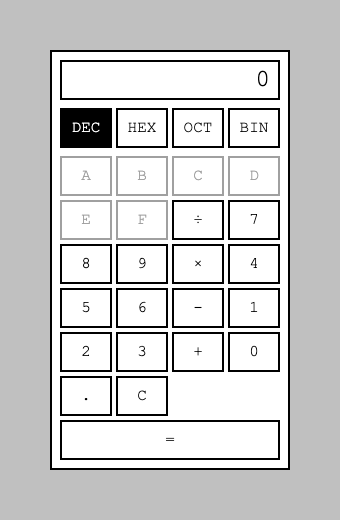
Programmer Mode's default state — Decimal active, the new mode row above the keypad, hex-only keys A–F already greyed out
I typed 255 in Decimal and switched to Hexadecimal:
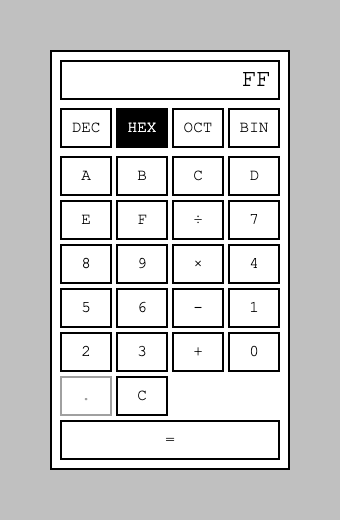
255 becomes FF on switching to Hexadecimal — exactly the scenario spec.md specified, and the decimal point key is now disabled
Then switched straight to Binary:
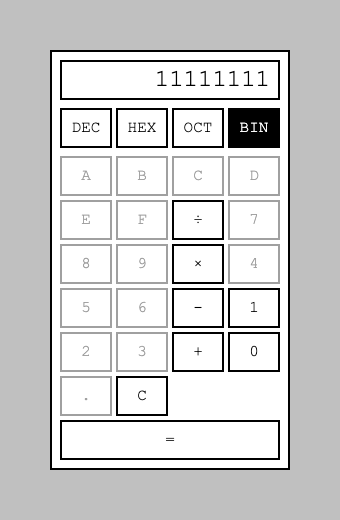
255 as 11111111 in Binary, with digits 2–9 and A–F all disabled — the per-base digit restriction working as designed, not just as specified
It matches the spec exactly, including the detail I would have expected to trip something up: positive values are not zero-padded to 32 bits (FF, not 000000FF), only negative values fill the full word, which is what toRadixString actually does and what the spec's own scenario called for.
Syncing the spec
PROMPT
1/opsx:sync add-programmer-mode
This is the step that actually tests OpenSpec's "delta specs merge into a living source of truth" pitch, rather than just asserting it. openspec/specs/ was empty before this — the baseline calculator was never spec'd — so syncing created openspec/specs/programmer-mode/spec.md from scratch. I diffed it against the delta spec propose wrote: the header changed from # Spec Delta to # programmer-mode Specification, and ## ADDED Requirements became a plain ## Requirements, but every requirement and scenario carried over verbatim. openspec validate --specs passed.
That is the honest, slightly less dramatic version of the claim: for a brand-new capability with only ADDED requirements, "intelligent merge" mostly means "reformat the headers." The more interesting case — folding a MODIFIED requirement into an existing one without losing a scenario the main spec already had — never got exercised here, because neither of my two proposals touches the same capability twice. Worth being upfront about: I have not actually seen OpenSpec's merge logic do the harder thing yet.
Archiving
PROMPT
1/opsx:archive add-programmer-mode
This did not just archive. It ran the sync check again, found the delta already matched the main spec, and then stopped:
"No warnings to report. Ready to archive now — shall I proceed, or would you like to sync anyway first?"
Everything was clean, and it still asked before doing the one step that moves files around. I said yes:
PROMPT
1Yes, proceed with archiving.
CODE
1## Archive Complete
2
3Change: add-programmer-mode
4Archived to: openspec/changes/archive/2026-09-29-add-programmer-mode/
5Specs: ✓ Already synced to main specs
The change folder moved from openspec/changes/add-programmer-mode/ to openspec/changes/archive/2026-09-29-add-programmer-mode/ — git recognized it as a pure rename — and openspec/specs/programmer-mode/spec.md stayed exactly where sync put it. That is the whole promise, actually delivered: a proposal that started as a delta is now indistinguishable, in the main specs directory, from documentation that was always accurate.
Proposing Statistics Mode
PROMPT
1/opsx:propose Add a Statistics Mode, like calculators have had since Windows 7 — enter a sequence of numbers and compute sum, average, and standard deviation.
Again, no clarifying question. This time it told me explicitly why:
"I based this directly on the existing
programmer-modecapability's precedent in this repo (same architecture, same flat UI aesthetic, same style of documenting judgment calls in design.md) rather than asking you to confirm details like the standard-deviation formula — that choice and its rationale are recorded in design.md."
That is a real, observable consequence of specs/ already holding one archived capability: the second proposal used the first as precedent instead of deciding from nothing. The judgment call I was watching for — sample vs. population standard deviation, since I never specified which — got the same treatment as Programmer Mode's word-size decision: a real Windows Calculator Statistics box actually exposes both (s and σ), but this proposal picked population only, and said exactly why:
"Population standard deviation is chosen because it is defined for every non-empty data set, including
n = 1(result0), whereas sample standard deviation divides by zero atn = 1and would need special-casing."
It also flagged a risk against itself, unprompted: disabling the operator and base-toggle keys is DOM-layer only (matching Programmer Mode's precedent), so calling engine.setOperator() directly while Statistics mode is active would not actually be blocked at the engine level. It accepted that gap deliberately rather than silently, on the grounds that the DOM never exposes those buttons as clickable while disabled.
Applying it
PROMPT
1/opsx:apply add-statistics-mode
Different behavior from the Programmer Mode apply run, on the exact same non-interactive constraint. Last time, when its npm test call got auto-declined, it hand-traced the logic and self-declared complete with a caveat. This time it stopped mid-flow and asked directly:
"
nodeexecution needs your approval to run the test suite — could you approve thenpm testcommand when prompted, or let me know if you'd rather I verify the logic differently?"
All the code was already written to disk when it stopped — engine, UI, and test file — it just had not checked the boxes in tasks.md yet. I ran the tests myself:
BASH
1npm test
CODE
1ℹ tests 46
2ℹ pass 46
3ℹ fail 0
All 46 pass — the 29 from before plus 17 new ones. I told it so in a follow-up turn, and it finished marking tasks.md and updating the README, again flagging honestly that it could not verify the browser UI itself. So I did:
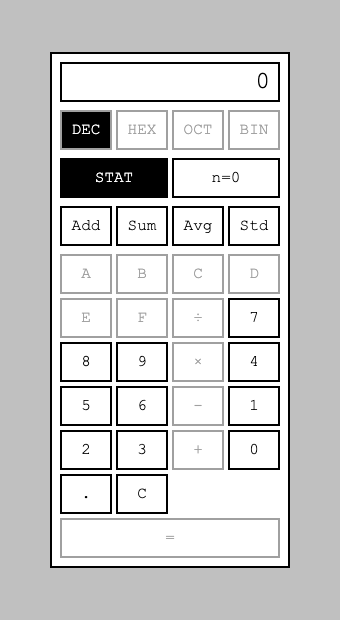
Statistics mode active: n=0, Add/Sum/Avg/Std keys present, and — as specified — the arithmetic operators, equals, and the DEC/HEX/OCT/BIN base toggle are all disabled
I entered 2, 4, and 6, pressing Add after each:
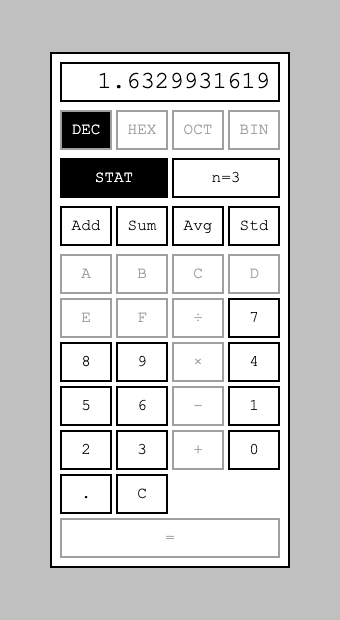
After Add ×3 (n=3) and pressing Std: 1.6329931619 — the population standard deviation of {2, 4, 6}, matching the spec's scenario to six decimal places
It matches. Two genuinely different apply runs against the same command, same repo, same non-interactive constraint — one self-declared with a caveat, one stopped and asked — a reminder that these are stochastic sessions, not a fixed script, even when the surrounding conditions are identical.
Sync and archive, the second time
/opsx:sync add-statistics-mode created openspec/specs/statistics-mode/spec.md the same way as before — verbatim content, headers reformatted, validate --specs passing. openspec/specs/ now holds two capabilities, programmer-mode and statistics-mode, from two separately archived changes, each still reading as accurate documentation of what the calculator actually does./opsx:archive add-statistics-mode did not pause to ask for confirmation this time — it went straight to archiving, unlike the Programmer Mode run, where everything was equally clean and it still stopped to check. Same command, same clean-checks situation, different behavior. Whatever is driving that is not visible from the outside, and it is worth knowing about before trusting either behavior as "how archive works."
Where this leaves OpenSpec
Two proposals, two full propose → apply → sync → archive cycles, forty-six tests, all real, all passing, all screenshotted. A few things I would not have predicted from the source article alone:
- "Assumes context, adds unstated rationale" undersells it. Every judgment call I watched it make — 32-bit word size, overflow wraparound, population over sample standard deviation, DOM-only key disabling — came with a named alternative it considered and rejected, in a dedicated Decisions section. It did not ask me, but it did not hide its reasoning either. Whether that is good enough is a real trade-off, not a defect: reading a
design.mdafter the fact is slower than being asked up front, but it leaves an audit trail a quick question would not. - The "living source of truth" claim held up, for the case I tested: two archived changes, two accumulated capabilities,
specs/reading as accurate both times. I did not get to see its more interesting claim — merging aMODIFIEDrequirement without losing an existing scenario — because neither proposal touched the same capability twice. - Run-to-run behavior varied more than I expected, on identical commands against identical repo state: one
applyself-declared with a caveat, the other stopped and asked; onearchivepaused for confirmation, the other did not. None of this was wrong, but it means "here is what OpenSpec does" is really "here is what it did in this run" — worth keeping in mind for Spec-Kit and BMAD too. - The only real gap was mine, not the tool's: running non-interactively meant
applygenuinely could not verify its own work, which is exactly why I rannpm testand clicked through the browser myself both times rather than taking its word for it.
Next: Spec-Kit, on the same two feature requests, against a fresh copy of the same baseline calculator.