Agentic AI for Professionals (Part 11)
Neil Haddley • September 17, 2026
The complete, real trace from a 15-citation JSON response landing in the browser to fifteen clickable, page-linked citation links on screen — with genuine, freshly-captured screenshots of the live running app, not illustrations — covering handleAsk, the fetch/Promise layer, renderAnswer's regex-based citation parser, and the split-pane PDF preview
Part 10 covered the React and TypeScript fundamentals needed to read this app's frontend. This post applies them directly, tracing the real major-failure question — the same one Parts 6 through 9 traced through the Python backend — from the moment its JSON response lands in the browser to the fifteen clickable citation links a person actually sees. Every screenshot below is genuine: captured live, directly from the same running app this whole series has been tracing against, moments before this post was written.
The real, live app
BASH
1# select "NSW Lemon Law Authorities (Jade live-fetch)" in the Database dropdown
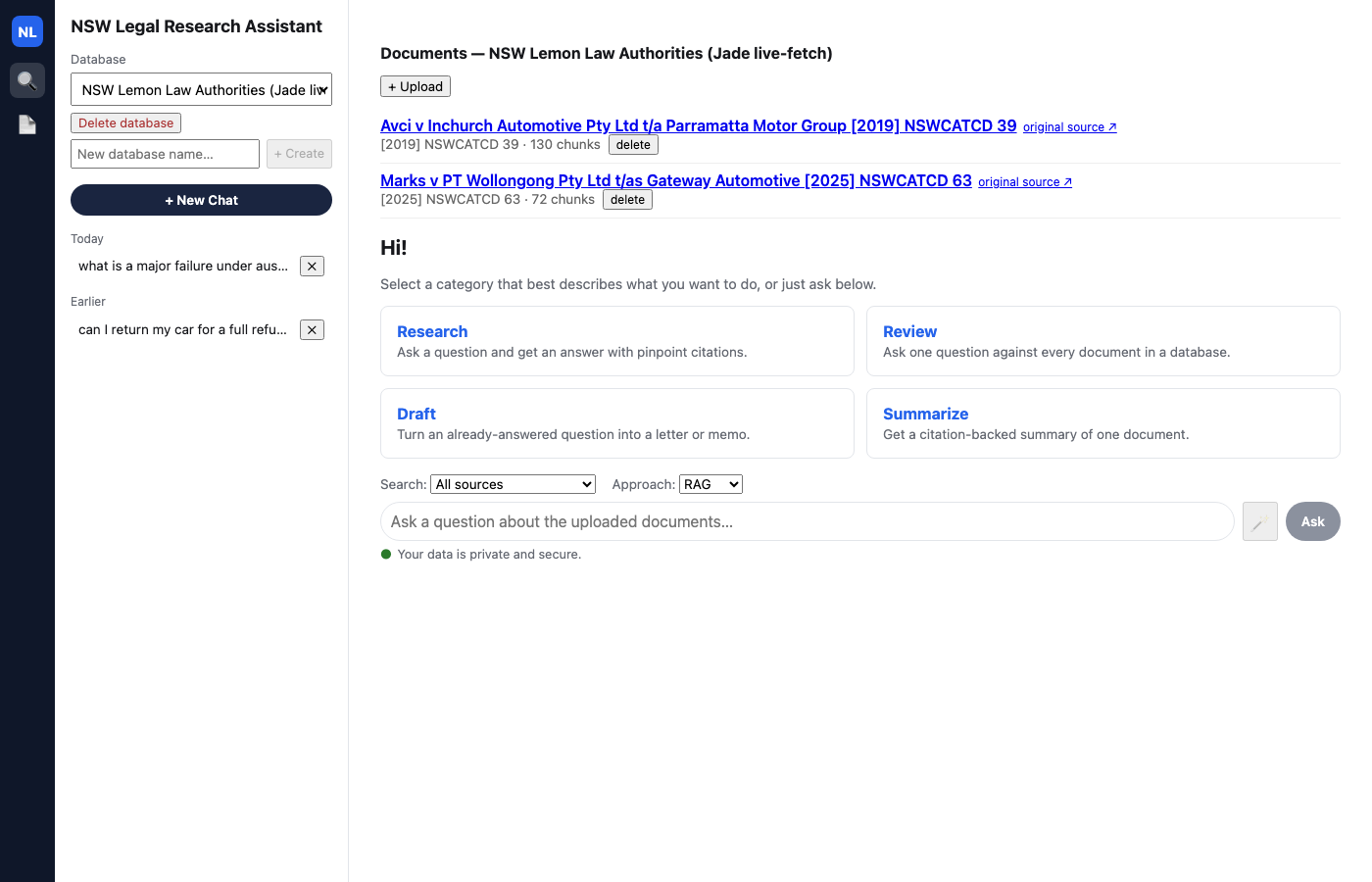
The real, live document list for the exact collection this series has traced throughout — 130 chunks for `Avci`, 72 for `Marks`, both real numbers confirmed independently against Postgres in Part 7
From JSON payload to clickable answer
askQuestion() is the one function every chat turn goes through:
TYPESCRIPT
1// frontend/src/api.ts
2export const API_BASE_URL = import.meta.env.VITE_API_BASE_URL ?? "http://localhost:8000";
3
4async function unwrap<T>(res: Response): Promise<T> {
5  if (!res.ok) {
6    const body = await res.text();
7    throw new Error(`${res.status} ${res.statusText}: ${body}`);
8  }
9  return res.json() as Promise<T>;
10}
11
12export function askQuestion(
13  question: string, collectionId?: string, history?: HistoryTurn[],
14  layer?: string, sessionId?: string, mode: QueryMode = "rag",
15): Promise<QAResponse> {
16  return fetch(`${API_BASE_URL}${QUERY_MODE_ENDPOINT[mode]}`, {
17    method: "POST",
18    headers: { "Content-Type": "application/json" },
19    body: JSON.stringify({ question, collection_id: collectionId || undefined, history, layer, session_id: sessionId }),
20  }).then(unwrap<QAResponse>);
21}
import.meta.env.VITE_API_BASE_URL ?? "http://localhost:8000" uses nullish coalescing (Part 10) to read an environment variable Vite bakes in at build/dev-server start, falling back to localhost:8000. fetch(url, {...}) is the browser's built-in function for making an HTTP request — JSON.stringify(...) converts a JavaScript object into JSON text (the mirror image of Python's json.loads), sent as the request body exactly as Part 6 traced arriving at POST /qa. unwrap is itself async: res.ok is true for any successful HTTP status; on failure, it throws a real JavaScript Error; on success, res.json() parses the response body from JSON text into a plain object — this is the exact moment the 15-citation answer, bytes on a network connection a moment earlier, becomes a real object this app's code can read fields off of.
Asking the real question: handleAsk
TYPESCRIPT
1// frontend/src/components/ChatPanel.tsx
2async function handleAsk() {
3  const q = question.trim();
4  if (!q || loading) return;
5  setLoading(true);
6  setError(null);
7  try {
8    const history = exchanges.slice(-4).map((ex) => ({ question: ex.question, answer: ex.result.answer }));
9
10    let activeSessionId = sessionId;
11    if (!activeSessionId) {
12      const created = await createChatSession(collectionId);
13      activeSessionId = created.id;
14      onSessionCreated(activeSessionId);
15    }
16
17    const result = await askQuestion(q, collectionId ?? undefined, history, layer || undefined, activeSessionId, mode);
18    setExchanges((prev) => [...prev, { id: crypto.randomUUID(), question: q, result, mode }]);
19    setQuestion("");
20  } catch (err) {
21    setError(String(err));
22  } finally {
23    setLoading(false);
24  }
25}
For the real question, typed as the first message of a new chat: try { ... } catch (err) { ... } finally { ... } is JavaScript's exception-handling structure — try runs normally; if anything inside throws (including unwrap's throw new Error(...) from a failed request), execution jumps to catch; finally always runs last, guaranteeing setLoading(false) fires either way, so the UI never gets stuck showing a permanent loading state.let activeSessionId = sessionId; if (!activeSessionId) { ... } — for a genuinely new chat, this branch runs: await createChatSession(collectionId) makes a real, separate POST /chat-sessions request before the question is even asked, and waits for it to finish; this is exactly why a real ChatSession row already exists in Postgres by the time the actual question is sent, and why the sidebar shows a "Today" entry immediately. onSessionCreated(activeSessionId) is a prop — a function passed down from a parent component, called here to let that parent update its own state with the new session id, since a child component can never directly modify a parent's state.setExchanges((prev) => [...prev, { id: crypto.randomUUID(), question: q, result, mode }]) is React's functional state update form: passing a function to a setter guarantees prev is the actual current state at the moment the update runs, correct regardless of timing, rather than a possibly-stale copy. crypto.randomUUID() is a browser built-in generating a random unique id, used purely as a React list key, unrelated to any database id.
A toy example: what .split() with a regex actually does
JAVASCRIPT
1const MARKER_RE = /(\[\d+\])/g;
2const text = "The sky is blue [1] and grass is green [2].";
3console.log(text.split(MARKER_RE));
4// ["The sky is blue ", "[1]", " and grass is green ", "[2]", "."]
Run this in any browser console or Node.js and it prints exactly that array — five pieces, alternating plain text and markers, because the regex's capturing parentheses tell .split() to keep the matched delimiters instead of discarding them (a plain .split(", ") with no parentheses would keep only the plain-text pieces and throw the markers away). The real answer text below produces the identical shape, just with 15 markers instead of 2 and real legal text instead of "the sky is blue."
The real answer, rendered
TYPESCRIPT
1// frontend/src/citations.tsx
2const MARKER_RE = /(\[\d+\])/g;
3
4export function renderAnswer(answer: string, citations: Citation[], onPreview?: (citation: Citation) => void) {
5  const byMarker = new Map(citations.map((c) => [c.marker, c]));
6  return answer.split(MARKER_RE).map((part, i) => {
7    const citation = byMarker.get(part);
8    if (!citation) return <span key={i}>{part}</span>;
9    return (
10      <a key={i} href={citationHref(citation)} title={citationTitle(citation)}
11         onClick={(e) => { e.preventDefault(); onPreview?.(citation); }}>
12        {part}
13      </a>
14    );
15  });
16}
/(\[\d+\])/g is a regular expression — \[ and \] match a literal square bracket, \d+ matches one or more digits, the parentheses mean "keep this matched part," and the g flag means "find every match, not just the first." answer.split(MARKER_RE) splits the answer text at every [n] marker, and because the pattern has capturing parentheses, JavaScript's .split() keeps the markers themselves in the result, interleaved with the plain text between them. new Map(citations.map((c) => [c.marker, c])) builds a lookup table so byMarker.get("[3]") instantly finds the right citation object. .map((part, i) => {...}) walks every piece and returns either a plain <span> or a clickable <a> — onPreview?.(citation) uses optional chaining (Part 10) so this never crashes when no preview handler exists.
Here is the real result, for the real answer, from the real, currently-running app:
![The genuine, live-rendered answer — every `[n]` marker a real clickable link, the "Documents" panel underneath listing all 15 real citations, exactly matching the JSON structure Part 8 traced](/assets/images/agenticaiforprofessionals11/3-grounded-answer-with-citations.png)
The genuine, live-rendered answer — every `[n]` marker a real clickable link, the "Documents" panel underneath listing all 15 real citations, exactly matching the JSON structure Part 8 traced
Clicking a citation: the split-pane preview
Clicking [3] — the s 260(a) statutory-language citation this series has traced since Part 7 — opens DocumentPreviewPane, a plain HTML iframe pointed at the real stored PDF:
TYPESCRIPT
1// frontend/src/components/DocumentPreviewPane.tsx
2<iframe src={url} title={title} style={{ flex: 1, border: "none" }} />
The frontend never re-derives which page a citation points to — it asks the backend for the URL (documentFileUrl(citation.document_id, citation.page_number)) and puts it directly in an iframe. The real result:
![The real page 4 of the real `Marks v PT Wollongong` judgment, opened by clicking citation `[3]` — the actual statutory text of s 260, quoted verbatim, confirming the citation resolves to genuine content rather than a broken reference](/assets/images/agenticaiforprofessionals11/4-citation-preview-pane.png)
The real page 4 of the real `Marks v PT Wollongong` judgment, opened by clicking citation `[3]` — the actual statutory text of s 260, quoted verbatim, confirming the citation resolves to genuine content rather than a broken reference
The right-hand pane's text — "it is convenient to set out s 260, which provides as follows: 260 When a failure to comply with a guarantee is a major failure..." — is the real source the answer's [3][4] markers point to. Nothing in the frontend generated this text; it is the actual judgment PDF, served by the backend, rendered by the browser's own PDF-handling inside an iframe.
The full round trip, end to end
Check your understanding
1. In the toy .split() example, what would text.split(/\[\d+\]/g) (the same pattern, but without the capturing parentheses) print instead? Why does that difference matter for renderAnswer()?
2. handleAsk calls createChatSession() and awaits it before calling askQuestion(). If those two calls were fired at the same time instead (without waiting for the first to finish), what real problem would that cause for _persist_if_session() on the backend (Part 6)?
3. renderAnswer() builds a Map from citations before mapping over the split pieces. Could the same lookup be done without a Map — say, with citations.find(c => c.marker === part) inside the .map() callback instead? What would be different about performance if the answer had 200 markers instead of 15?
4. Clicking citation [3] opens an iframe pointed at a URL built from citation.document_id and citation.page_number. If the backend's /documents/{id}/file endpoint were down, what would the user actually see happen when they clicked [3] — and which of the two real screenshots in this post would still render correctly regardless?
What is next
This post traced the complete round trip for a real question, ending with a real citation resolving to real, verifiable source text. Part 12 covers the drafting UI's client-side half, how the frontend is actually hosted, and what a genuine end-to-end test for this exact flow would need to assert to prove the whole stack — database through browser — actually works together.