Agentic AI for Professionals (Part 12)
Neil Haddley • September 17, 2026
The drafting UI's client-side half, traced against a genuine live screenshot; how the React frontend is actually hosted in Docker today; a real, illustrative Playwright end-to-end test for this exact question, explained line by line; and a closing recap of the full eight-part arc from a single CREATE EXTENSION statement to a browser tab open on a real page of a real judgment
Part 11 traced the real question all the way to a citation resolving to a real page of a real judgment. This post closes the loop: the drafting UI's client-side half, how the whole frontend is hosted, what a genuine end-to-end test for this exact flow would need to assert, and a recap of everything Parts 5 through 12 have shown, together, about how this app actually works.
Drafting, in the same panel
The "Draft from this…" affordance and the inline instruction box both call draftFromAnswer(), passing back exactly the question, answer, and citations ChatPanel already holds in its own component state from the /qa call Part 11 traced — no re-fetch, matching Part 8's point that drafting never touches retrieval again:
TYPESCRIPT
1// frontend/src/components/ChatPanel.tsx
2const result = await draftFromAnswer(exchange.question, exchange.result.answer, exchange.result.citations, instr);
Here is the real, live result — captured directly from the running app while writing this series, not staged:
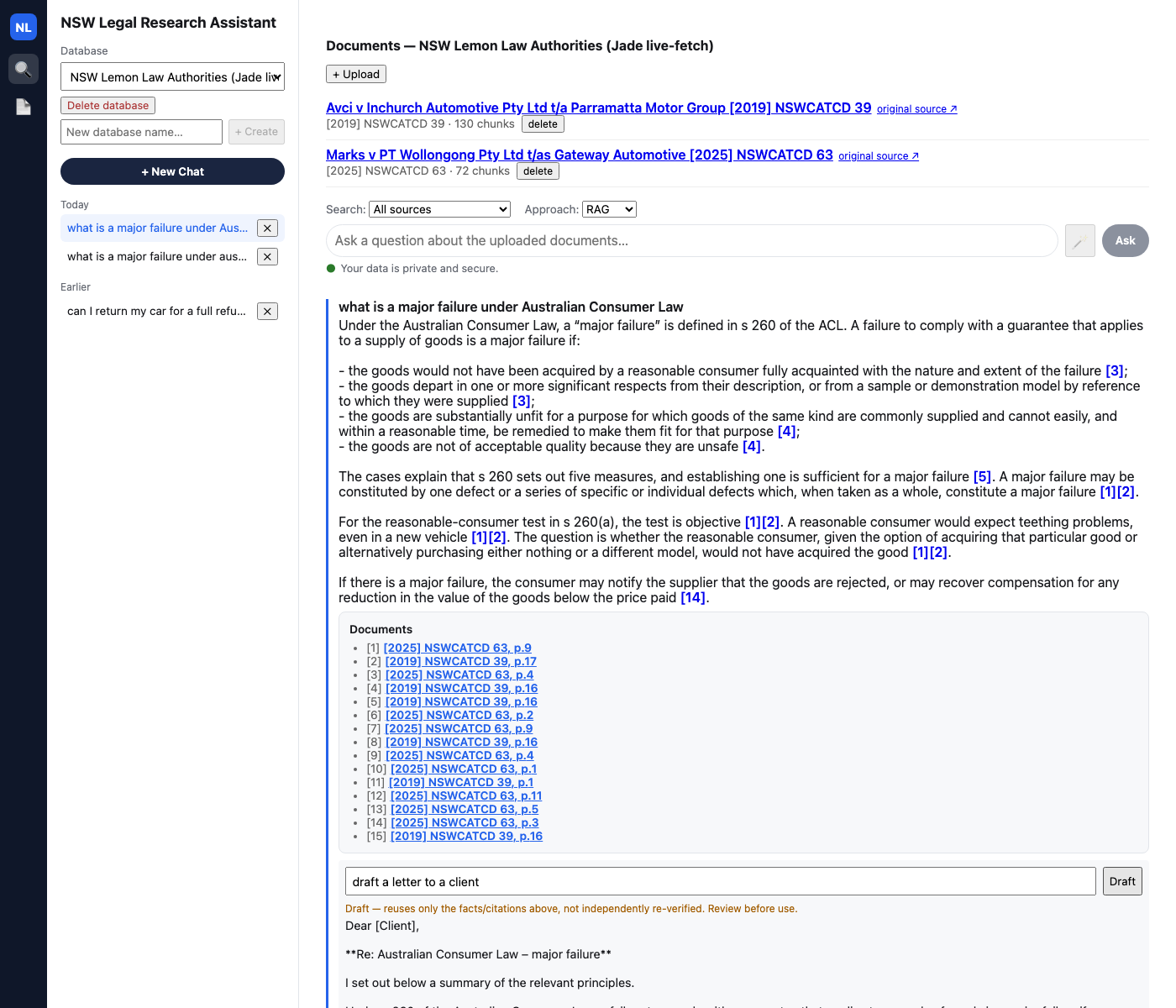
The real drafting UI: an instruction box, a "Draft" button, and the app's own disclaimer printed directly beneath the output — "Draft — reuses only the facts/citations above, not independently re-verified. Review before use."
The frontend does not compute that disclaimer sentence from anything — it is static text sitting next to a feature whose backend contract genuinely guarantees what the sentence says, which is exactly why it is trustworthy as a UI label rather than decorative copy.
Hosting the frontend
DOCKERFILE
1# frontend/Dockerfile
2FROM node:20-alpine
3WORKDIR /app
4COPY package.json ./
5RUN npm install
6COPY . .
7EXPOSE 5173
8CMD ["npm", "run", "dev"]
node:20-alpine is an official Node.js image built on the minimal Alpine Linux distribution. npm install reads package.json — a file listing every JavaScript package this project depends on — and downloads all of them. npm run dev runs Vite's own dev server (Part 10 covers what Vite actually does) inside the container — hot module reloading, unminified, not a production build. npm run build (tsc -b && vite build) exists in package.json and produces a real static production bundle, but nothing in the repo serves that bundle anywhere yet — no Nginx container, no CDN, no static hosting target committed — consistent with the backend's own production deployment still being unbuilt (Part 9). As of this post, "hosting" for the whole three-layer stack — Postgres, FastAPI, React — is the same answer at every layer: docker compose up, on one machine, the exact stack this entire series has been tracing against, live.
A toy Playwright test, before the real one
Every end-to-end test, however elaborate, is the same three-step shape: go somewhere, do something, check something.
TYPESCRIPT
1import { test, expect } from '@playwright/test';
2
3test('the page has the right title', async ({ page }) => {
4  await page.goto('https://example.com');
5  await expect(page).toHaveTitle('Example Domain');
6});
page is a real, automated browser tab Playwright controls; page.goto(...) navigates it; expect(page).toHaveTitle(...) is an assertion that either holds or fails the test with a clear message naming what it expected versus what it found. The real test below is the identical shape, extended: more goto/fill/click steps to reach a more interesting state, more assertions checking more specific things — never a different kind of tool, just more of the same three moves chained together.
What an end-to-end test for this exact question would need to assert
There is no committed frontend test suite in this repo today — no Vitest, no React Testing Library, no Playwright config. The real Playwright verification behind an earlier phase of this app's build caught a genuine bug (Content-Disposition defaulting to attachment, so citation clicks silently downloaded the PDF instead of opening it) — a real, valuable session that simply did not leave a repeatable test file behind. What follows is not a claim that this test exists; it is what one would look like, written against the exact code and real behaviour this series has already traced and screenshotted.
TYPESCRIPT
1// frontend/tests/e2e/lemon-law-major-failure.spec.ts (illustrative — not yet in the repo)
2import { test, expect } from '@playwright/test';
3
4test('major-failure question against the Lemon Law collection returns a grounded,
5      citation-backed answer, and drafting from it reuses those citations verbatim', async ({ page }) => {
6  await page.goto('/');
7  await page.getByLabel('Database').selectOption({ label: /NSW Lemon Law Authorities/ });
8
9  await page.getByPlaceholder('Ask a question about the uploaded documents…')
10    .fill('what is a major failure under australian consumer law');
11  await page.getByRole('button', { name: 'Ask' }).click();
12
13  const citations = page.locator('.result-card >> role=listitem');
14  await expect(citations).toHaveCount(15);
15  await expect(page.getByText('s 260')).toBeVisible();
16
17  await page.getByRole('link', { name: '[3]' }).click();
18  await expect(page.frameLocator('iframe').getByText('Page 4')).toBeVisible();
19
20  await page.getByPlaceholder(/draft a letter/i).fill('draft a letter to a client');
21  await page.getByRole('button', { name: 'Draft' }).click();
22  const draft = page.locator('text=Dear').locator('..');
23  await expect(draft).toContainText('[3]');
24  await expect(page.getByText(/not independently re-verified/)).toBeVisible();
25});
test('description', async ({ page }) => {...}) is Playwright's own function for declaring one test — page is provided by Playwright, a real, automated, headless browser tab. page.getByRole(...), page.getByPlaceholder(...), and page.getByText(...) are Playwright's preferred way of finding elements — by their accessible role or visible text, the same way a real person would identify them, rather than by an internal implementation detail like a CSS class name. expect(citations).toHaveCount(15) and expect(...).toBeVisible() are assertions — Playwright's equivalent of Python's assert (Part 9) — each a specific claim that must hold or the test fails and reports exactly which one did not.
Three assertions, three different layers proven to actually work together, not separately: 15 citations proves Parts 6 through 8's retrieval and generation ran for real against the real Postgres collection; the iframe assertion proves Part 11's citation-to-page link actually resolves to real content; the draft assertion proves this post's draft_from_answer() genuinely reused the prior answer's citations rather than silently re-querying or inventing new ones. A unit test could mock any one of these in isolation and pass regardless of whether the other two layers were even running — which is exactly why this app's own real verification discipline has leaned on full-stack scripts and manual Docker Compose runs rather than a large mocked test suite: for an app whose entire value proposition is "every citation is real," the test that matters most is the one that cannot be satisfied by a mock.
Check your understanding
1. draft_from_answer() (Part 8) is called with the prior answer and citations already sitting in ChatPanel's component state (Part 11). If the browser tab were closed and reopened right before clicking "Draft from this…," would the drafting feature still work the same way? What state would no longer be available, and where would it need to come from instead?
2. The illustrative e2e test's third assertion checks that the draft contains [3]. If draft_from_answer() had a bug that silently dropped every citation marker from its output, would any of this app's real 40 unit tests (Part 9) catch that? Why is the e2e test the one that would actually catch it?
3. This post says npm run build produces a real static bundle that "nothing in the repo serves ... anywhere yet." Concretely, what would a developer need to add — one new file, one new service — to actually serve that bundle the way nginx or a CDN would in production?
4. Across Parts 5 through 12, name one claim this series made that was checked live against the running app rather than assumed from reading source code, and explain what would have been wrong if that check had never happened.
The full arc, closed
Eight posts, one real question, traced without a single fabricated number:
Part 5 was a database willing to hold real chunks and answer a cosine-distance query honestly. Parts 6 through 9 were the Python service turning that into a grounded, cited answer — and, this time, a genuine correction about which language model actually answers, caught only by checking the running system rather than trusting a default. Parts 10 through 12 were the browser rendering it faithfully — fifteen clickable links, an iframe that opens on the exact page a citation claims, and a disclaimer that describes a real backend guarantee rather than a decorative one. None of the layers trusts the one above it to have done its job correctly; each is a real, separately verifiable thing that either did or did not do what it claims, all the way from a CREATE EXTENSION vector; run once to a browser tab open on "Page 4" of a real Tribunal decision. That is the actual answer to whether this app's grounding guarantee is real or just a well-written system prompt: it is real, because at every layer above the prompt, there is something else checking its work.
One honest gap remains even after all of that: every post in this arc traced a question against chunks that already existed. Part 13 covers how they got there in the first place — the real ingestion pipeline, two genuine production bugs that shaped it, and the actual configuration files a developer would need to reproduce this stack from nothing.