Agentic AI for Professionals (Part 3)
Neil Haddley • August 19, 2026
Giving nsw-legal-research-assistant a real interface and an MCP server exposing the same skill to Claude Code, then running it through the same demo Thomson Reuters used to introduce CoCounsel, live, with real output — grounded Q&A, pinpoint citations, Review, and skill-chaining drafting
Part 1 covered the research and the plan; Part 2 covered the RAG core — retrieval, generation, and citations that can't be hallucinated, all running locally on the M4 MacBook Air. This post is Phases 4 through 6: giving nsw-legal-research-assistant a user interface, exposing the same skills to Claude Code over MCP (and other MCP clients), and then running it live against a demo script taken directly from the interview where Thomson Reuters' Valerie McConnell walked Legal IT Insider through CoCounsel Legal's "Search a Database" and "Review Documents" skills — the McConnell interview documented back in Part 1's research.
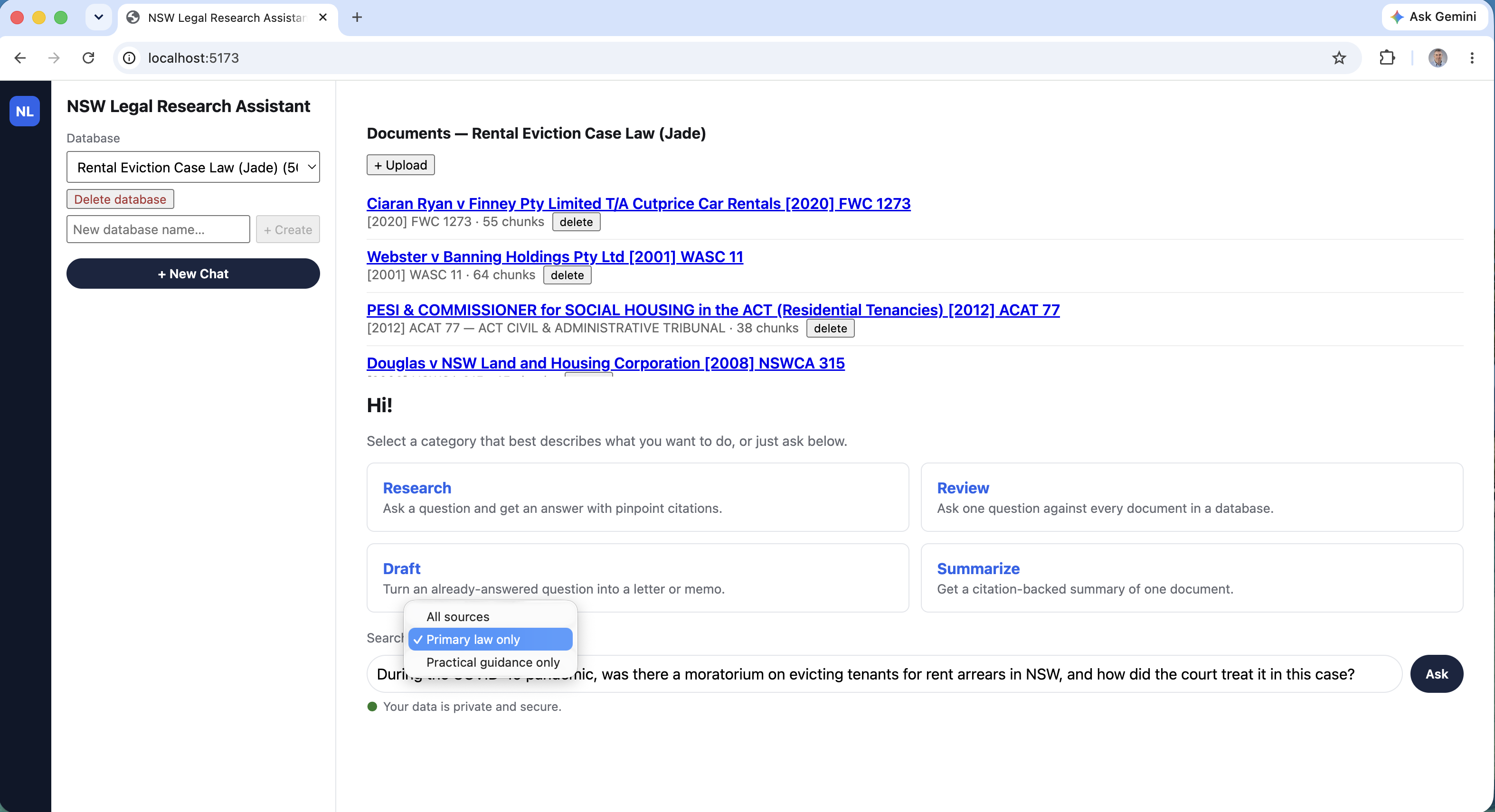
The app with a database selected
Beat 1 — Grounded Q&A, scoped to a database
McConnell's demo queried named databases. That's the reason this app has a database selector. Asking a question with "All Documents" selected searches though every chunk of every uploaded document; scoping to one database (Rental Eviction Case Law (Jade)) will provide much more useful results.
During the COVID-19 pandemic, was there a moratorium on evicting tenants for rent arrears in NSW, and how did the court treat it in this case?
Example output:
A moratorium on evicting tenants for rent arrears existed during the COVID-19 pandemic in NSW. From [2], we see that the Residential Tenancies Regulation 2019 (NSW) was amended to include a new Part 6A "Response to COVID-19 pandemic," which provided for a "moratorium period" of six months (reg 41A). The moratorium did not apply in this specific case because the tenant was not an "impacted tenant" — there was no evidence to allow a finding that Mr Herbert was an "impacted tenant," and therefore the protections given by the regulation were not engaged.
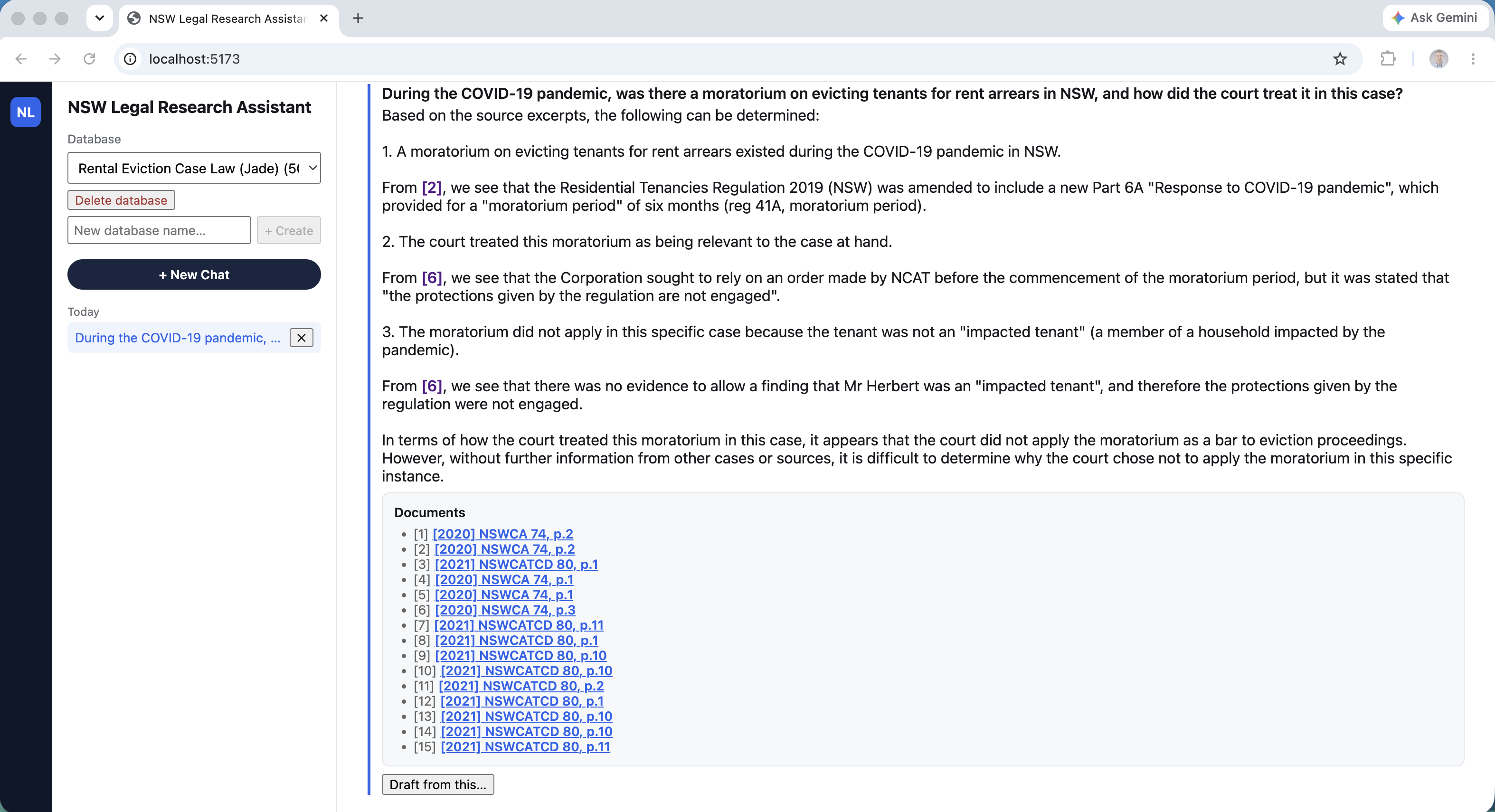
Grounded answer with fifteen inline citation markers across two documents, each linking to a specific page of a specific document
Every claim carries a bracket marker. That's the whole trust mechanism in one screen — click one.
Beat 2 — Pinpoint citations, and the state where they can't be trusted blindly
Click [1] and the source PDF opens, scrolled to the page the details came from — the same "show its work" pattern McConnell described as CoCounsel's core trust mechanism, a hyperlink plus an excerpt backing every claim so a professional can verify without redoing the research. The citation metadata — case name, page number — is read directly off the retrieved database row, never generated by the model, so which excerpt gets cited is the LLM's call, but the citation itself can't be hallucinated.
Every citation in the run above is a verified source: a human found, downloaded, and uploaded the document, so its provenance is known — which is why those markers render as plain bold text with no warning.
Beat 3 — Review: one row per document
The Review skill asks a series of questions to every document individually.
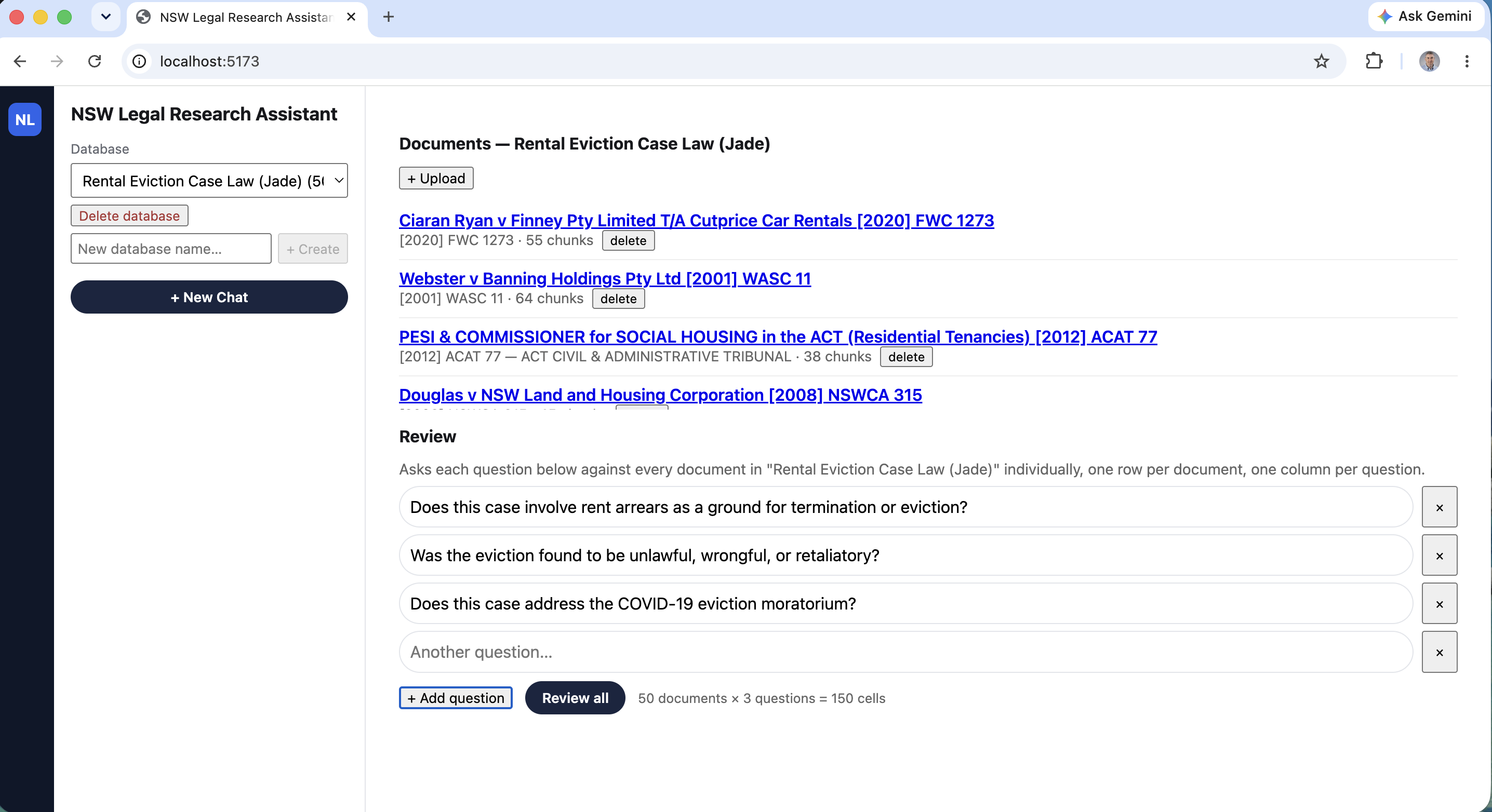
Three questions queued against the Rental Eviction Case Law (Jade) database — 50 documents × 3 questions
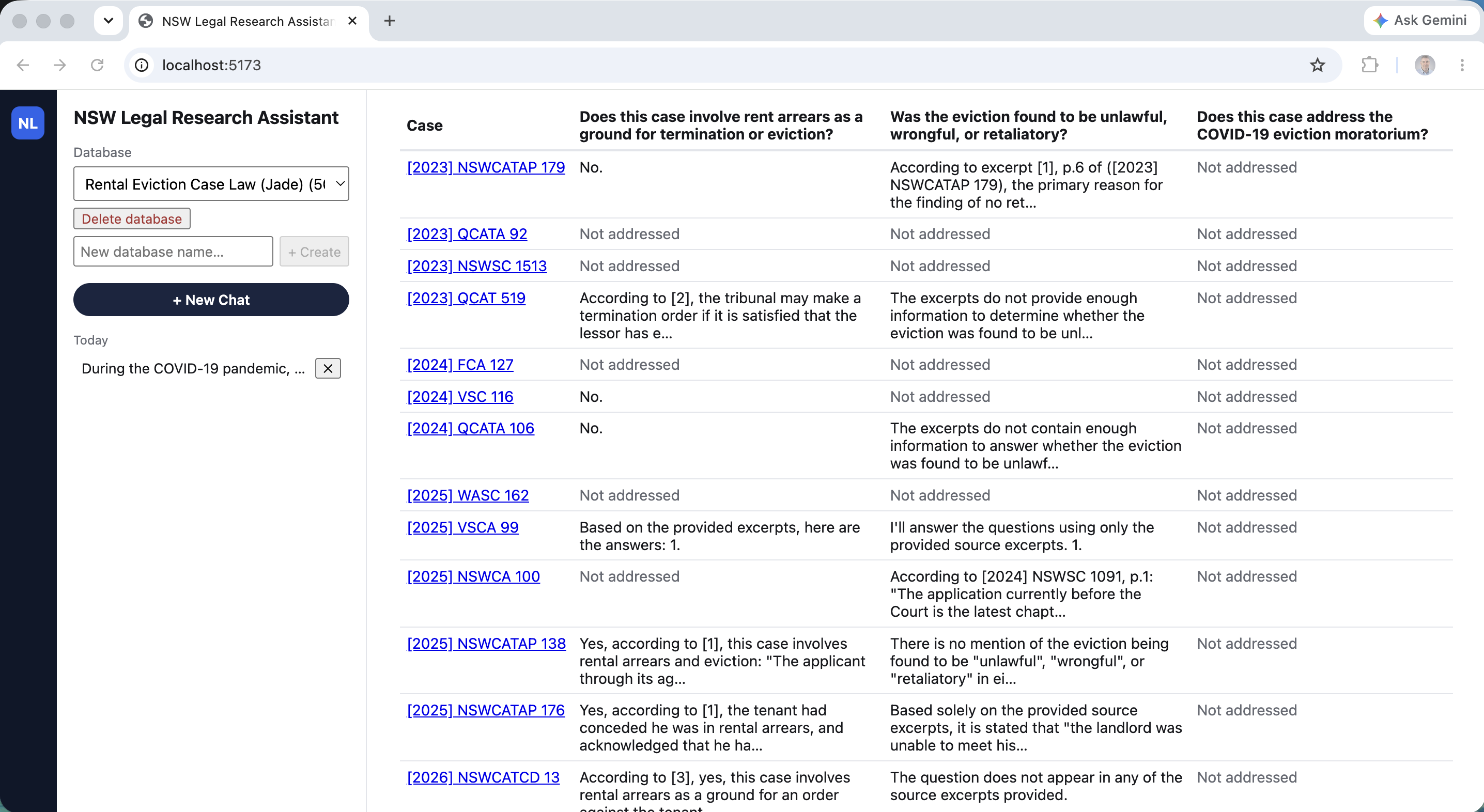
The finished grid — three questions (rent arrears as a termination ground, unlawful/retaliatory eviction, the COVID-19 moratorium) answered independently against every document in the database
Beat 4 — Skill-chaining: draft from an answer, no re-supply
McConnell's most complex demo move: approve a database answer, then say "draft a letter from that," with no re-upload and no re-running the search. Same move here — enter a description then click Draft:
draft a letter to the client summarizing this outcome
Real output:
Dear Client,
Re: COVID-19 Moratorium on Evictions in NSW
As you may recall, we were discussing the application of the COVID-19 moratorium on evicting tenants for rent arrears in NSW. In light of our previous research and findings [1], I am writing to inform you that a moratorium did exist during the pandemic period.
During this time, a new Part 6A "Response to COVID-19 pandemic" was added to the Residential Tenancies Regulation 2019 (NSW), which included a moratorium period of six months [2]. However, in our specific case, the court found that the protections given by this regulation were not engaged because you were not an "impacted tenant," as there was no evidence to support this designation [6].
In particular, the court noted that the tenant (you) was not a member of a household impacted by the pandemic, and therefore the moratorium did not apply in our specific case. As such, the court allowed the eviction proceedings to continue.
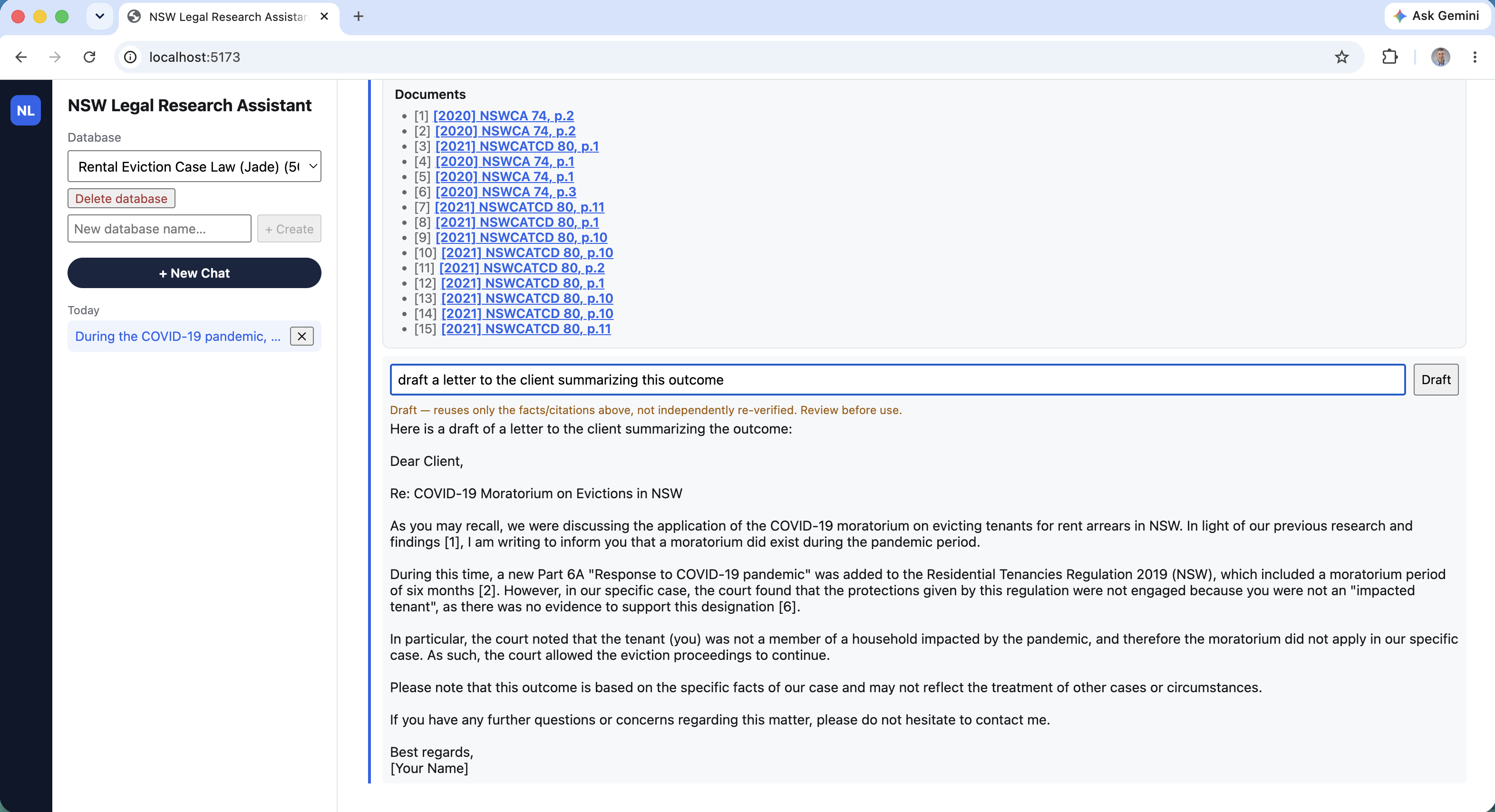
The drafted letter, reusing only the figures and facts already on screen, with a review-before-use disclaimer
No new retrieval happens here — the exact answer and citations already on screen get passed straight back to a second LLM call, explicitly forbidden from introducing new facts or citations. It's deliberately stateless: the frontend, not the server, holds the "conversation" by re-sending what it already has, rather than a session table on the backend. That statelessness is also why the guardrail is worth testing honestly rather than cherry-picked: asking it to draft from an answer that hadn't actually established an outcome produced a correct refusal instead of a fabricated finding — a clean refusal on ungrounded ground is a stronger trust signal than a draft that always complies.
Beat 5 — Beyond the original demo
Not part of McConnell's demo — Model Context Protocol (MCP) wasn't discussed at all in the interview. ask_nsw_caselaw, introduced above, is the MCP tool matching Beat 1's Q&A skill. This same build shipped two more, mirroring the two skills it added: review_nsw_caselaw_collection for Beat 3, and draft_from_nsw_caselaw_answer for Beat 4. All three are thin wrappers calling the exact same functions the REST API and the frontend call — same skill, multiple interfaces.
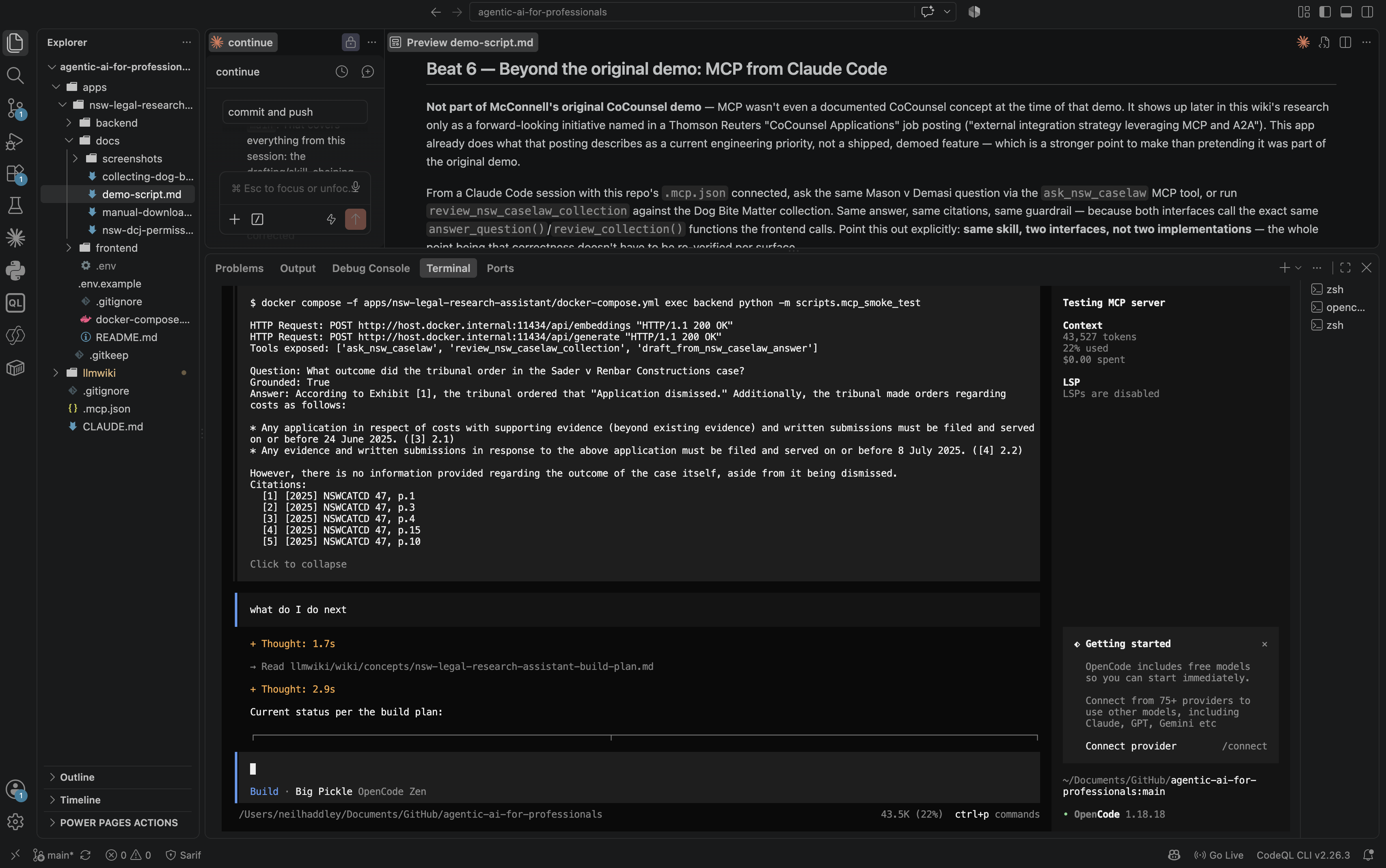
A real MCP client/server round trip — spawning app/mcp_server.py as an actual subprocess over stdio, the same transport Claude Code uses, not a direct Python call — against the live stack:
CODE
1Tools exposed: ['ask_nsw_caselaw', 'review_nsw_caselaw_collection', 'draft_from_nsw_caselaw_answer']
2
3--- review_nsw_caselaw_collection ---
4Question: What caused the plaintiff's injuries in this case?
5  - Your Right to Compensation for Dog Bites — RMB Lawyers: grounded=False
6    I couldn't find anything relevant to this question in the uploaded documents...
7  - A User's Guide to Civil Liability in Australia 2026 (NSW) — Colin Biggers & Paisley: grounded=True
8    Unfortunately, I am unable to answer this question as it relies on an unverified source: [20]...
9  - [2012] NSWCA 210: grounded=True
10    Unfortunately, I am unable to find any information on what caused the plaintiff's injuries...
11
12--- draft_from_nsw_caselaw_answer ---
13Instruction: Draft a short memo to a colleague summarizing what the research above establishes.
14Draft: To: Colleague
15
16Regarding: Mason v Demasi dog bite claim judgment
17
18As per my previous research, I found that in Mason v Demasi, the court set aside an earlier
19judgment and ordered a new trial limited to damages [1] ([2012] NSWCA 210, p.4)...
What caused the plaintiff's injuries in this case?
Same shape as the browser — the same mix of grounded and not-found rows across the five documents, the same reused-figures-only drafting behavior — because both interfaces are calling review_collection() and draft_from_answer() directly, not a second reimplementation of them. The exact wording differs from Beats 3 and 4's screenshots, same as it does between any two runs of this app; the guarantee is architectural, not word-for-word reproducibility.
Where this actually runs
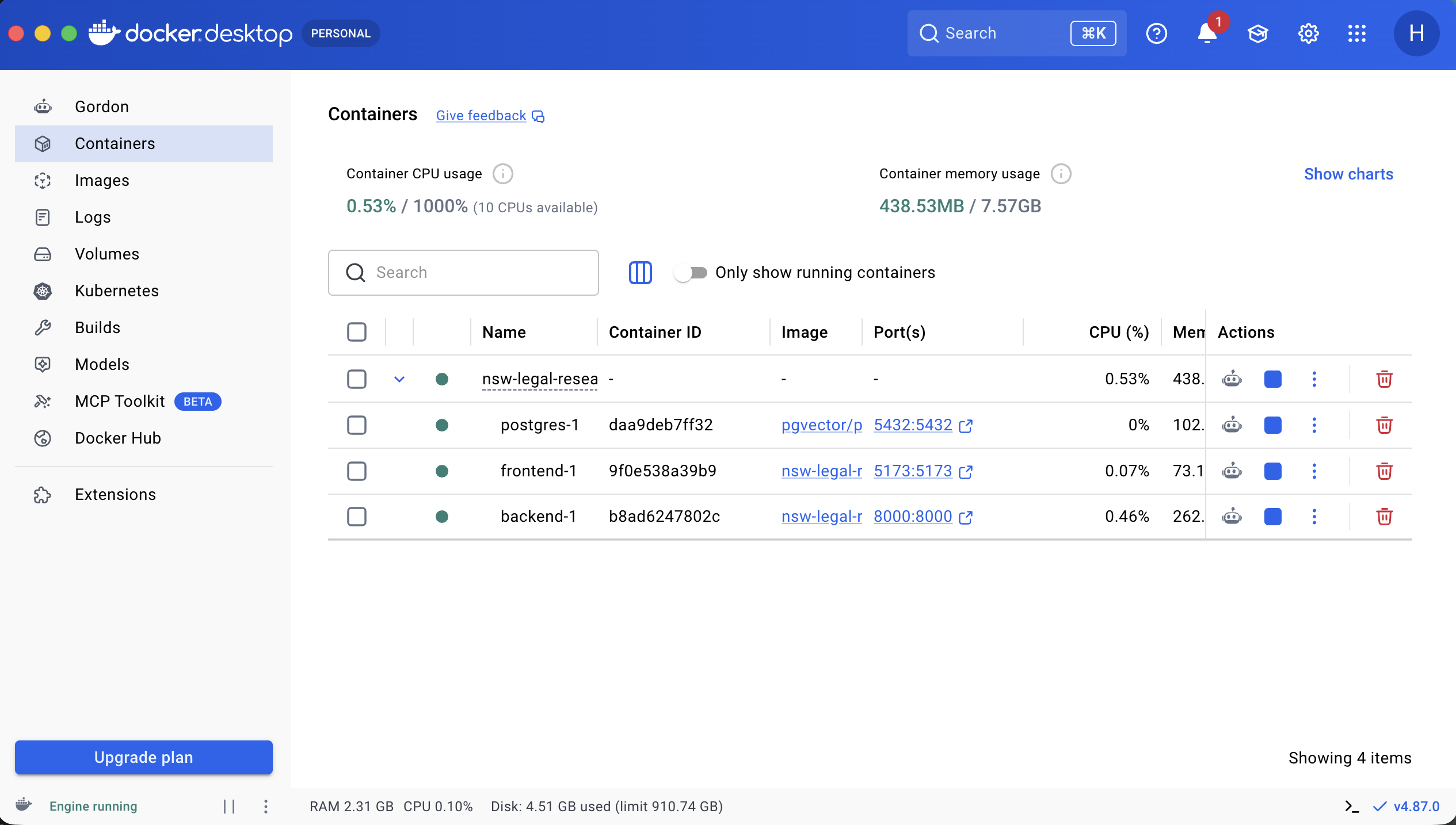
Four containers, all healthy: postgres, backend, frontend, and the compose project itself — 438.53MB RAM, 0.53% CPU at idle
Honest comparison to the original demo
| McConnell's CoCounsel demo | This app, run live | |
|---|---|---|
| Scale | 38,000 SEC filings / 1,200-contract set | 5 documents in this post's original database, up to 50 in databases added since |
| Named, scoped databases | Yes | Yes |
| Grounded, citation-linked Q&A | Yes | Yes |
| Trend/risk analysis | Yes, within "Search a Database" itself | Yes, as a separate Review skill |
| Conceptual/synonym-aware search | Yes ("pandemic" matches "epidemic") | Embedding similarity only — related, not identical |
| Skill-chaining (Q&A → drafting) | Yes ("draft a letter from that") | Yes — stateless: client passes back the prior answer/citations, no new facts allowed |
| Domain-expert evaluation | Licensed lawyers writing test suites | Manually-verified questions, plus isaacus/open-australian-legal-qa identified as a spot-check benchmark (not yet wired into an automated run) — solo-developer scale |
| MCP/external integration | Not part of the demo (predates the concept) | Shipped, demoed here as a bonus |
What this app isn't trying to be: a reproduction of CoCounsel at enterprise scale. What it is: the same architectural pattern — curated, scoped RAG with a non-negotiable citation-grounding trust mechanism — proven against a real matter, with the actual gaps between "toy demo" and "useful tool" identified, closed where reasonable, and reported honestly where not.