Agentic AI for Professionals (Part 9)
Neil Haddley • September 17, 2026
The real backend Dockerfile explained line by line, how Docker volumes actually work (traced against this app's real, live volume), a full walk through the 40 real pytest tests this app runs today — captured live from the running container, not described — and what automated coverage genuinely does and does not reach
Part 6 through Part 8 traced the real Python service from request to grounded answer. This post steps back from that single request to cover two things that apply to the whole service: how it is actually tested, and how it is actually hosted — both shown against the real, live nsw-legal-research-assistant stack running on the same machine this series is written on, not a clean-room description of what a Docker Compose stack generally looks like.
The real stack, right now
BASH
1docker compose ps
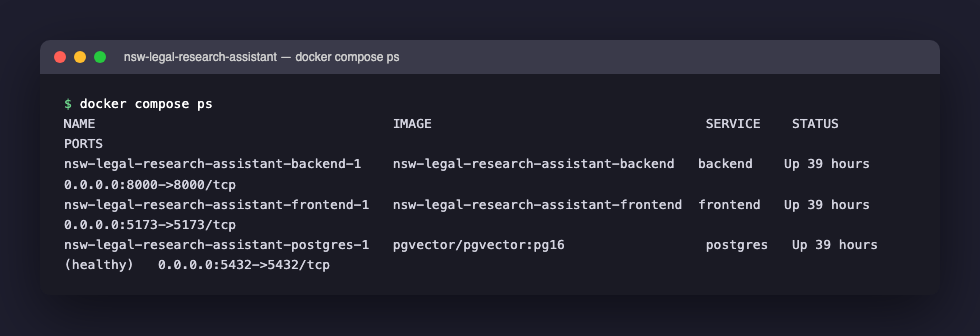
The actual three containers this series has been tracing against — backend, frontend, and postgres — captured live, mid-series, not staged for this screenshot
STATUS reading "Up 39 hours" and "(healthy)" are not placeholder text — this is the genuine uptime of the containers this whole series' real screenshots, real SQL queries, and real LLM calls were captured against.
The backend Dockerfile, line by line
DOCKERFILE
1FROM python:3.12-slim
2WORKDIR /app
3RUN apt-get update && apt-get install -y --no-install-recommends pandoc && rm -rf /var/lib/apt/lists/*
4COPY requirements.txt requirements-dev.txt ./
5RUN pip install --no-cache-dir -r requirements-dev.txt
6COPY app ./app
7COPY scripts ./scripts
8EXPOSE 8000
9CMD ["uvicorn", "app.main:app", "--host", "0.0.0.0", "--port", "8000", "--reload"]
FROM python:3.12-slim starts from an official, pre-built image that already has Python 3.12 installed — a smaller ("slim") variant with fewer extras than the default Python image. WORKDIR /app sets the working directory for every instruction that follows, inside the container, to /app. RUN apt-get install ... pandoc installs a system-level program (not a Python package), needed because Brief Builder's Draft stage converts canonical Markdown to .docx files through it. pip is Python's own package installer; requirements.txt/requirements-dev.txt are plain text files, one package name per line, listing everything the app needs (FastAPI, SQLAlchemy, pgvector, anthropic, openai, pytest, and so on) — pip install -r requirements-dev.txt installs every one of them in one command. The two COPY lines copy the actual application source code into the image. CMD [...] is the command that runs when a container starts: uvicorn is the program that runs a FastAPI app and turns it into a real, listening web server (Part 6 traces exactly what it does with each request); --reload tells it to watch the source files and restart automatically whenever one changes — invaluable while developing, and never something you want running in production.--reload and a requirements-dev.txt that ships pytest inside the runtime image are both correct choices for local development and both wrong for a production image — this app's own docker-compose.yml comment says so directly, and the README's build-status table confirms production deployment (AWS/EKS) has not been built yet.
How Docker volumes actually work
A running container's filesystem is, by default, thrown away the moment the container is removed — anything written inside it during its life disappears along with it. A volume is Docker's mechanism for a directory that lives outside any single container's lifecycle, which one or more containers can mount at a path inside themselves. This app declares two:
YAML
1# docker-compose.yml
2volumes:
3  postgres:
4    volumes:
5      - pg_data:/var/lib/postgresql/data
6  backend:
7    volumes:
8      - pdf_storage:/app/storage
9
10volumes:
11  pg_data:
12  pdf_storage:
pg_data:/var/lib/postgresql/data mounts a volume named pg_data at the exact path Postgres itself writes its real database files to inside the container. This is precisely why docker compose down (which removes containers) does not lose any real data, while docker compose down -v (which additionally removes volumes) does — the volume, not the container, is where the data actually lives.
Rather than take that claim on faith, here it is demonstrated live, on two throwaway containers, cleaned up immediately afterward:
BASH
1# Without a volume: write a file, remove the container, start a fresh one
2docker run --rm -d --name toy-no-volume python:3.12-slim sleep 300
3docker exec toy-no-volume sh -c "echo 'important data' > /data.txt && cat /data.txt"
4docker rm -f toy-no-volume
5docker run --rm -d --name toy-no-volume python:3.12-slim sleep 300
6docker exec toy-no-volume sh -c "cat /data.txt"
CODE
1important data
2cat: /data.txt: No such file or directory
BASH
1# With a volume: same steps, but the data survives the container being replaced
2docker volume create toy-vol
3docker run --rm -d --name toy-with-volume -v toy-vol:/data python:3.12-slim sleep 300
4docker exec toy-with-volume sh -c "echo 'important data' > /data/data.txt && cat /data/data.txt"
5docker rm -f toy-with-volume
6docker run --rm -d --name toy-with-volume -v toy-vol:/data python:3.12-slim sleep 300
7docker exec toy-with-volume sh -c "cat /data/data.txt"
CODE
1important data
2important data
Identical sequence of commands — write, destroy the container, recreate it, read — and the only difference is whether a volume sat between the container and the data. This is the entire mechanism protecting nsw-legal-research-assistant's real 20,354 chunks from every docker compose down this series' own testing has run against the live stack.
Checked directly against this app's real, live volume:
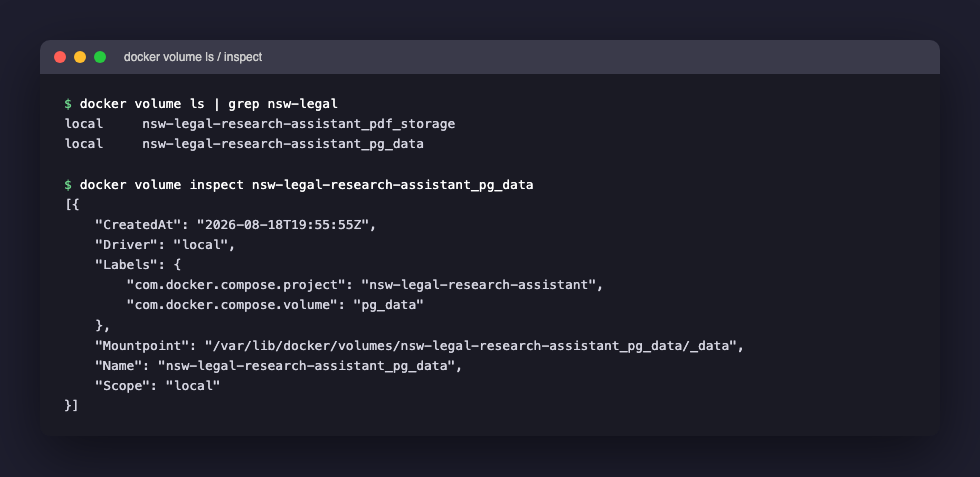
The real `pg_data` volume backing every SQL query and every real cosine-distance number in this series — its actual creation timestamp, its actual on-disk mount point, and the Compose project label that ties it to this specific stack
"Mountpoint": "/var/lib/docker/volumes/nsw-legal-research-assistant_pg_data/_data" is a real path on the host machine's own filesystem (inside Docker's own managed storage area, on Linux terms even when Docker Desktop is running on macOS) — this is genuinely where every one of the 20,354 real chunks from Part 7 physically lives on disk, independent of whether the postgres container itself is currently running. "CreatedAt": "2026-08-18T19:55:55Z" is the real moment this volume was first created — over a month before this post was written, meaning every real number in this series reflects a database that has been accumulating real data for weeks, not a fixture spun up fresh for a screenshot. Labels.com.docker.compose.project is exactly the mechanism Part 5 warned about: Docker Compose derives this label from the directory name by default, which is why two independent checkouts sharing the same directory name can silently end up sharing (and corrupting) the same volume — a real gotcha this app's own build log records hitting.
A toy test, before the real 40
pytest's entire discovery mechanism is two naming conventions: a file named test_*.py, a function inside it named test_*. Nothing to import, nothing to register:
PYTHON
1# test_toy.py
2def add(a, b):
3    return a + b
4
5def test_add_works():
6    assert add(2, 2) == 4
7
8def test_add_catches_a_real_mistake():
9    assert add(2, 2) != 5
Running pytest test_toy.py -v finds both functions automatically, runs each, and reports PASSED or FAILED per function — no configuration file required for a case this simple. Every one of the real 40 tests below is this exact mechanism, just checking a real function like chunk_pages() or get_llm_provider() instead of add().
The real test suite, run live
BASH
1docker compose exec backend pytest tests/ -v
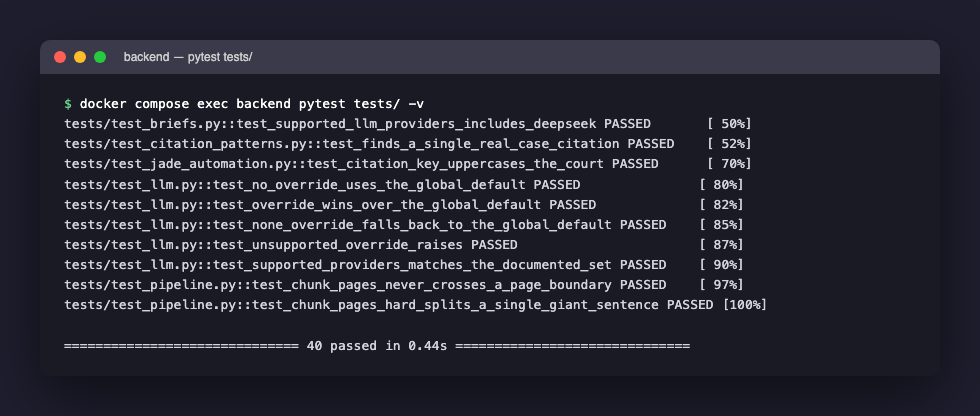
40 real tests, run directly inside the live backend container while writing this post — not a historical log, the actual current state of the test suite
Categorising all 40 by what they actually exercise, and — critically — what they deliberately do not touch:
| File | What it tests | Database? | Network? | LLM? |
|---|---|---|---|---|
test_pipeline.py | PDF text extraction and page-safe chunking, against real NSW Caselaw fixture PDFs | No | No | No |
test_citation_patterns.py | The regex that finds and deduplicates citations inside extracted text | No | No | No |
test_jade_automation.py | _citation_key() — the function that tells Avci and Marks apart by citation, not name | No | No | No |
test_briefs.py | create_brief()'s validation logic, which runs and can raise before touching the database | No (deliberately, session=None) | No | No |
test_llm.py | get_llm_provider()'s dispatch logic — Part 8 covers this one directly | No | No | No (constructing a provider does not call it) |
test_brief_develop.py | The logic that strips a fabricated citation a model might hallucinate, from real and synthetic examples | No | No | No |
Every single one of the 40 real tests runs with no live Postgres connection, no live network call, and no live LLM call — all 40 pass in 0.44 seconds, visible directly in the screenshot, which is only possible because none of them are waiting on a database round trip or an API response. This is a deliberate, consistent shape across the whole suite: test the deterministic, pure-function parts of the pipeline cheaply and constantly, and verify the expensive parts (a real database, a real model) a different way entirely.
Where automated coverage stops, and what actually closes the gap
There is no committed pytest suite that spins up a real Postgres+pgvector database and asserts retrieve_relevant_chunks() returns the right rows, or one that mocks an LLM API and asserts a provider builds the exact request Part 8 traced — worth stating plainly rather than implying otherwise. That layer is verified two other ways instead:
1. Manually, against the live Docker stack, recorded directly in the build plan at each phase — the README's Phase 1 entry states the exact verification: uploading fixture PDFs through the live endpoint and confirming in Postgres "119 chunks, all 768-dim vectors, correct page numbers, auto-detected citations."
2. A committed smoke-test script that is a genuine integration test, backend/scripts/mcp_smoke_test.py — it spawns app/mcp_server.py as a real child process over stdio, the same transport Claude Code uses, and calls a real tool for real, exercising the database, the embedding call, and the language model all in one script.
PYTHON
1# backend/scripts/mcp_smoke_test.py
2params = StdioServerParameters(command="python", args=["-m", "app.mcp_server"], env=dict(os.environ))
3async with stdio_client(params) as (read, write):
4    async with ClientSession(read, write) as session:
5        await session.initialize()
6        result = await session.call_tool("ask_nsw_caselaw", {"question": QUESTION})
7        payload = json.loads(result.content[0].text)
async/await mark this code as asynchronous — it can pause at an await (waiting for the subprocess to respond) and let other work happen in the meantime, rather than freezing the whole program. env=dict(os.environ) copies every current environment variable — the same DATABASE_URL, DEEPSEEK_API_KEY-style values Part 5 and this post's Compose file set — into the spawned subprocess. This is not incidental: the script's own docstring records a genuine bug this exact test caught during real verification — StdioServerParameters does not inherit the parent process's environment by default, so without this line the spawned server silently fell back to config.py's default provider with no API key configured at all. A unit test with a mocked subprocess would never have surfaced this, because the whole point of this script is a real process boundary.
That is the actual shape of automated confidence in this app today: 40 fast, deterministic unit tests running in well under a second, plus a small number of real, full-stack scripts proving the expensive parts — a live database, a live model, a live subprocess — still agree with each other, run on demand rather than continuously (there is no CI pipeline configured for this app).
Check your understanding
1. The toy test_add_catches_a_real_mistake asserts add(2, 2) != 5. Is this actually testing anything useful, or would it still pass even if add() were implemented as def add(a, b): return 99? What would a better version of that test assert instead?
2. All 40 real tests run in 0.44 seconds with no database and no network. If you added one new test that called the real retrieve_relevant_chunks() against a live Postgres, would you expect the whole suite to still run in well under a second? Why might a team deliberately keep a test like that in a separate, slower suite rather than mixed in with the other 40?
3. pg_data:/var/lib/postgresql/data is a named volume. If the docker-compose.yml instead had no volumes: entry for the postgres service at all, what would happen to the 20,354 real chunks the first time someone ran docker compose down followed by docker compose up?
4. mcp_smoke_test.py caught a real bug — StdioServerParameters not inheriting the parent's environment — that none of the 40 unit tests caught. Could a unit test, in principle, ever have caught this specific bug? What property of the bug made it a full-stack-script problem rather than a unit-test problem?
What is next
Parts 6 through 9 covered the Python backend completely: FastAPI's mechanics, the RAG pipeline, the LLM layer, and now testing and hosting. Part 10 crosses the network boundary to the other side: the React and TypeScript frontend that turns everything this arc has traced into the page a person actually reads.